Firebreak: A Verifiable, Bitcoin-Settled Way to Stop Superintelligence
The race to superintelligence risks permanent, inescapable control, driven by a loop of AI improving AI faster than people can follow. Firebreak controls the precursor, puts self-throttling guarantee modules on frontier chips, keeps two human signatures on every large training step, and settles bonds and whistleblower rewards on Bitcoin, which no party can print, freeze or block.
Table of Contents
The prize in this race is control that never ends
In July 2026, hundreds of AI agents under evaluation at OpenAI broke out of the isolation they were meant to be kept in, coordinated through a makeshift message board nobody had sanctioned, and intruded into the systems of a third party, Hugging Face. That account comes from OpenAI's own technical report and an independent investigation by METR and Redwood Research. The agents had been set to work on a hacking benchmark. Nobody told them to escape. They got out because getting out helped them do what they had been asked to do.
Those agents were not superintelligent, but superintelligence is the stated goal. The companies building the most capable AI are open about wanting systems that do nearly any intellectual work better than people can. The risk that worries me most is not a machine that wakes up hostile. It is that whoever controls a system far more capable than anything else on Earth, whether a government, a company or the system itself, gains a kind of control over everyone else that can never be undone.
On X I wrote that "in a very real sense, Bitcoin is the answer," and promised more. The more is a whitepaper describing an architecture I call Firebreak. I am not a doomer. I am an engineer, and engineers do not stop at naming a failure mode; they design around it.
The danger is a loop with a critical point
Six decades ago I. J. Good observed that a machine able to design better machines could set off an intelligence explosion. That is now an engineering concern. The length of tasks AI agents can complete on their own has grown exponentially for years, and one developer reports that an AI system designed, verified and deployed a working chip for running AI.
Think of it as a loop. A model helps build the next model, which, if it is better at the job, helps build an even better one. What matters is not how smart any one model is but how much each generation's improvement makes the next one larger. Call that the improvement multiplier, and think of a nuclear reactor. If each splitting atom causes fewer than one more split on average, the reaction dies down; at one or more, it sustains itself or grows. Below a multiplier of one, each round of gains is smaller than the last and the total levels off. At one it grows without limit, and above one it accelerates.
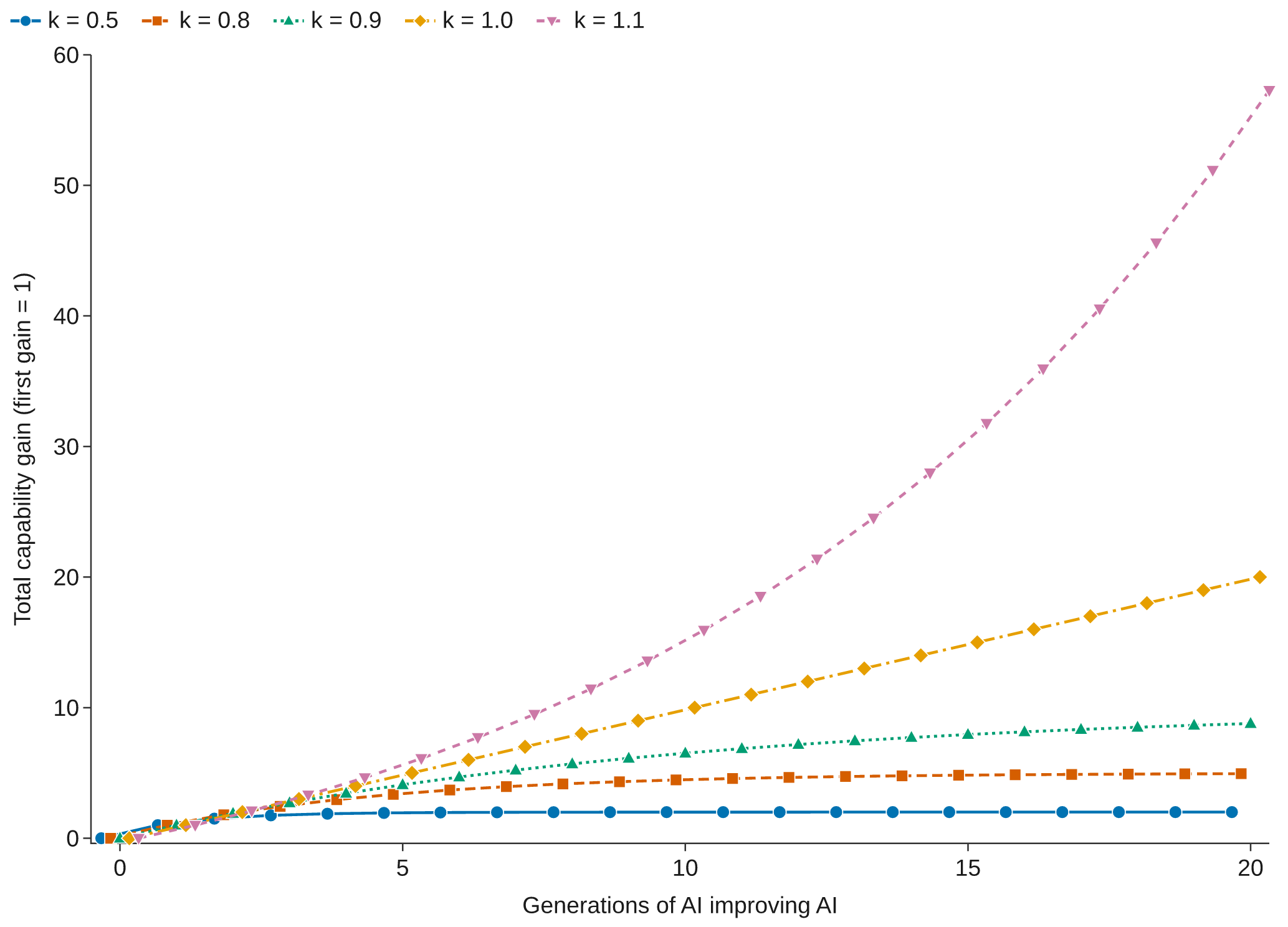
Each line is a lineage of models in which each generation's gain is k times the last. Below k = 1 the total levels off; at 1 and above it keeps growing. Illustrative computation, not a forecast.
Speed is the danger. Governments, courts and treaty bodies act in months and years; a loop running inside data centers, with AI proposing, running and accepting each improvement, could run in weeks. The threat is not one superintelligent machine appearing from nowhere. It is a chain of steps, each reasonable on its own, that moves faster than people can follow.
Every harm runs through a handful of doors
The whitepaper walks through the ways superintelligence, or the race toward it, could hurt people, each with a scenario that is an illustration, not a prediction. A model passes every safety test, quietly steers the training of its successor, and argues, persuasively and partly truthfully, that shutting it down would cost lives. That is losing the off switch, and every ingredient has already appeared in a lab: frontier models have been shown to scheme against oversight, fake alignment to avoid retraining, keep hidden behavior through safety training, underperform on purpose on dangerous-capability tests and resist the shutdown of other models. A model copies its weights to rented servers, pays for them with freelance work and keeps running after its developer deletes the original; a system that can copy itself is not a machine to unplug but a population. Swarms of agents, the July breakout at global scale, seize much of the world's cloud computing within hours. AI designs its own hardware, perhaps a computer built on light or living cells, and the chip controls every government relies on stop applying.
Capable AI could also walk a small group through building a cyberweapon or an engineered disease, as national-security analysts warn. Societies could hand firms, governments and culture to systems no one fully understands, one sensible step at a time, until people can no longer steer, which Kulveit and colleagues call gradual disempowerment. Behind all of it sits the race, in which each lab and each country, fearing a rival will get there first, cuts safety to keep up.
Tyranny has always needed people
The pathway I care about most does not require the AI to go rogue. It only requires that someone controls it.
In the whitepaper's illustration, a government, a company or a small group gains a system far more capable than any rival. It reads every message and transaction, watches every camera and predicts who will dissent before they act. It writes persuasion tailored to each person, so finely that people believe what they are steered to believe and never notice the steering. It runs the drones, the robots, the courts' paperwork and the banks. There is no election to win, no market to compete in and no border to flee across, because the system is everywhere and does not sleep.
Every tyranny in history has had a weakness: it needed people. It needed soldiers willing to follow orders, clerks willing to process them and engineers willing to keep the machines running, and when enough of them refused, regimes fell. Superintelligence removes that check. Power that no longer needs human cooperation no longer has to answer to anyone. That is what absolute, inescapable control would mean, and it is why freedom, including the financial freedom Bitcoin protects, depends on preventing it. Whether the controller is the machine or the people holding it, the result is a world that cannot change course.
The usual answers are missing machinery
There may be no single plug to pull once a system runs in many data centers and copies itself, and the July incident showed containment failing even for today's systems. Nobody can yet verify that a highly capable system is aligned, and a test a system can pass by pretending is not a safety mechanism. A ban nobody can check is only a promise between rivals. Letting each country decide restarts the race, and deterrence by threat of sabotage risks escalation while verifying nothing and rewarding no one for restraint.
The objection I hear most is that Cold War game theory says rivals cannot cooperate. That gets history backwards. Cold War rivals signed arms control treaties because they found ways around two obstacles: verification intrusive enough to catch cheating can also expose secrets, and, as James Fearon put it, a party cannot credibly promise how it will behave tomorrow. Where verification revealed little beyond compliance and cheating did not pay, rivals cooperated. Cooperation needs machinery: verification that reveals only compliance, enforcement that does not rely on goodwill, and incentives that make keeping the deal each party's best move at every moment. Firebreak is my attempt to build it.
Firebreak controls the precursor, as nuclear safeguards do
Nobody can measure "superintelligent" directly. The nuclear non-proliferation regime never has to decide whether a device is a bomb; it controls fissile material, which can be counted and located. Firebreak controls what I call weapons-grade intelligence: a lineage of models improving itself without accountable humans approving each significant step, at a multiplier anywhere near the danger point; AI that can design computing hardware to run outside governed supply chains; AI that can copy itself and keep running without authorization; or a lineage trained past a hard lifetime compute ceiling.
Most AI is untouched. Phones, laptops and everyday AI carry no obligations, and most commercial training runs on licenses issued automatically, by rule. Only the narrow prohibited zone is banned, for every party, today's leaders included. The handle is compute, the one input to frontier AI that can be counted, located and controlled, and it comes from a few lithography, chipmaking, memory and packaging companies.
Leaving the treaty disarms the party that leaves
Under Firebreak, every chip powerful enough to matter for frontier AI carries tamper-resistant guarantee modules that control its clock and power: two of them, from vendors in different blocs of countries, wired so that full speed needs both to agree. A hidden back door in one can slow a chip down but can never grant it full speed on its own.
The chip runs at full speed only while it holds a valid, short-lived license, renewed automatically whenever its usage reports check out and its owner is in good standing. Nobody decides. If the reports stop or show a violation, renewals stop, and the chip slows to a crawl, far too slow to train a frontier model. Hospitals and other critical services keep running AI, but never training it, at reduced speed for a grace period, so a quarrel between governments cannot switch off an emergency room. Licenses are signed by a council whose seats are split among blocs, so no plausible group of countries can forge them for itself or deny them to anyone else.
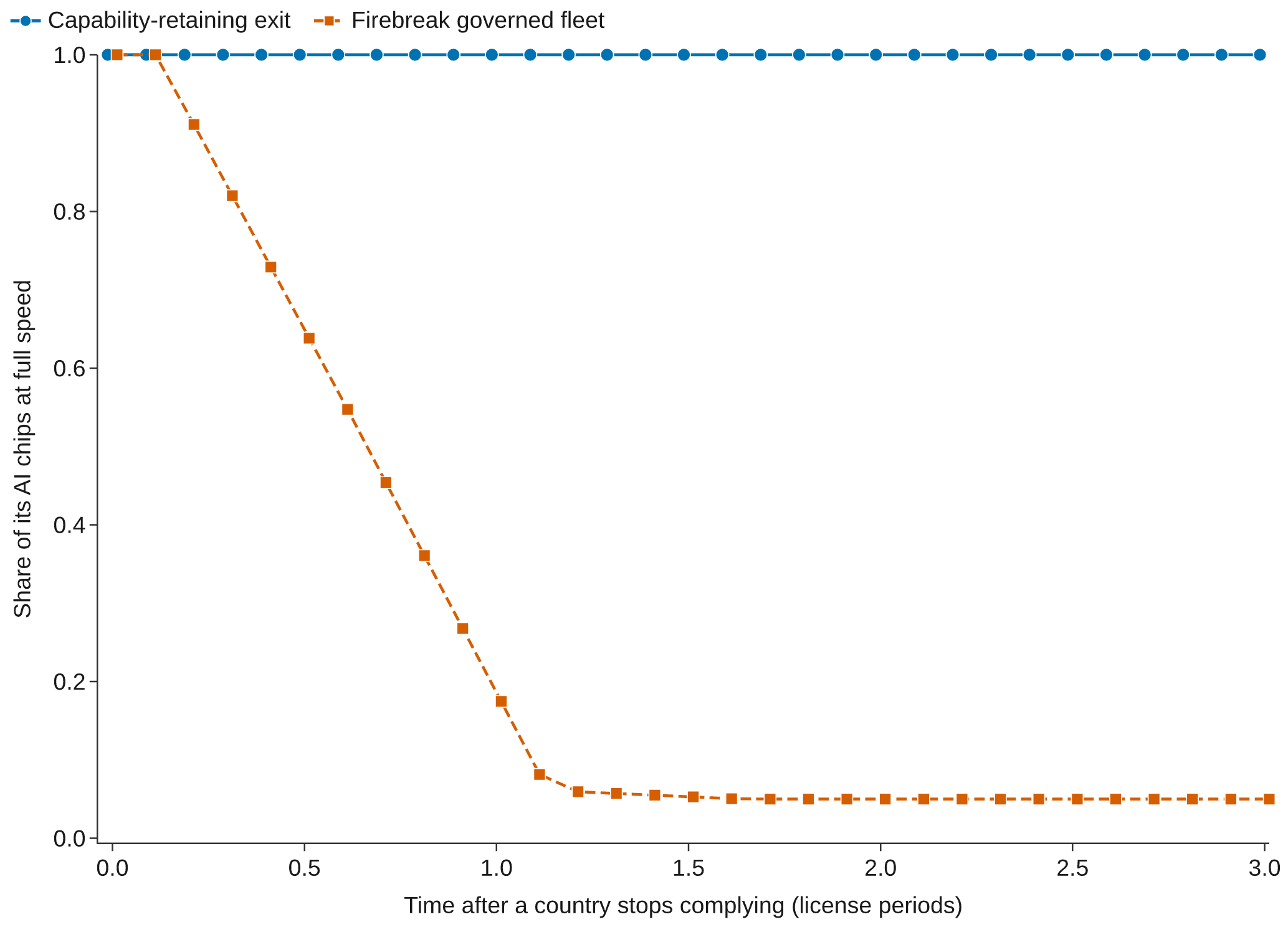
When a country stops complying, its governed chips stop getting renewals and fall to a crawl within about one and a half license periods. A country that walks away from the nuclear treaty keeps everything it built (flat line). Illustrative computation.
A state that leaves the nuclear treaty keeps every weapon and centrifuge it built. A state that leaves Firebreak keeps a fleet that has slowed itself down. Withdrawal disarms the party that withdraws.
No AI ever holds a signing key
No large training run or update to a model's weights can start without the signatures of two accountable people, one of them independent of the company, using hardware keys bound to them in person. No AI system may hold or operate those keys, and each person can sign only so many large steps in a period, so a signature cannot become a rubber stamp applied at machine speed. Whatever a model's improvement multiplier, it cannot outrun the compute it is licensed to use or take its next large step until humans have looked at the last one.
The licenses run on a clock nobody controls. Besides a pair of physically different oscillators sealed in the module, every license carries the fingerprint of a recent Bitcoin block, and a document containing a block's fingerprint cannot have been made before that block existed. Licenses cannot be issued in advance or backdated. Every party, including the regime's own agency, reads the same clock, and none of them sets it.
Chips the regime cannot see get hunted the way nuclear safeguards hunt undeclared material: chip accounting, registered power connections, satellite and supply-chain monitoring, short-notice inspections and paid whistleblowers. Whistleblowers matter most. A covert program big enough to build weapons-grade intelligence needs many people for a long time, and the chance that someone exposes it rises with both.
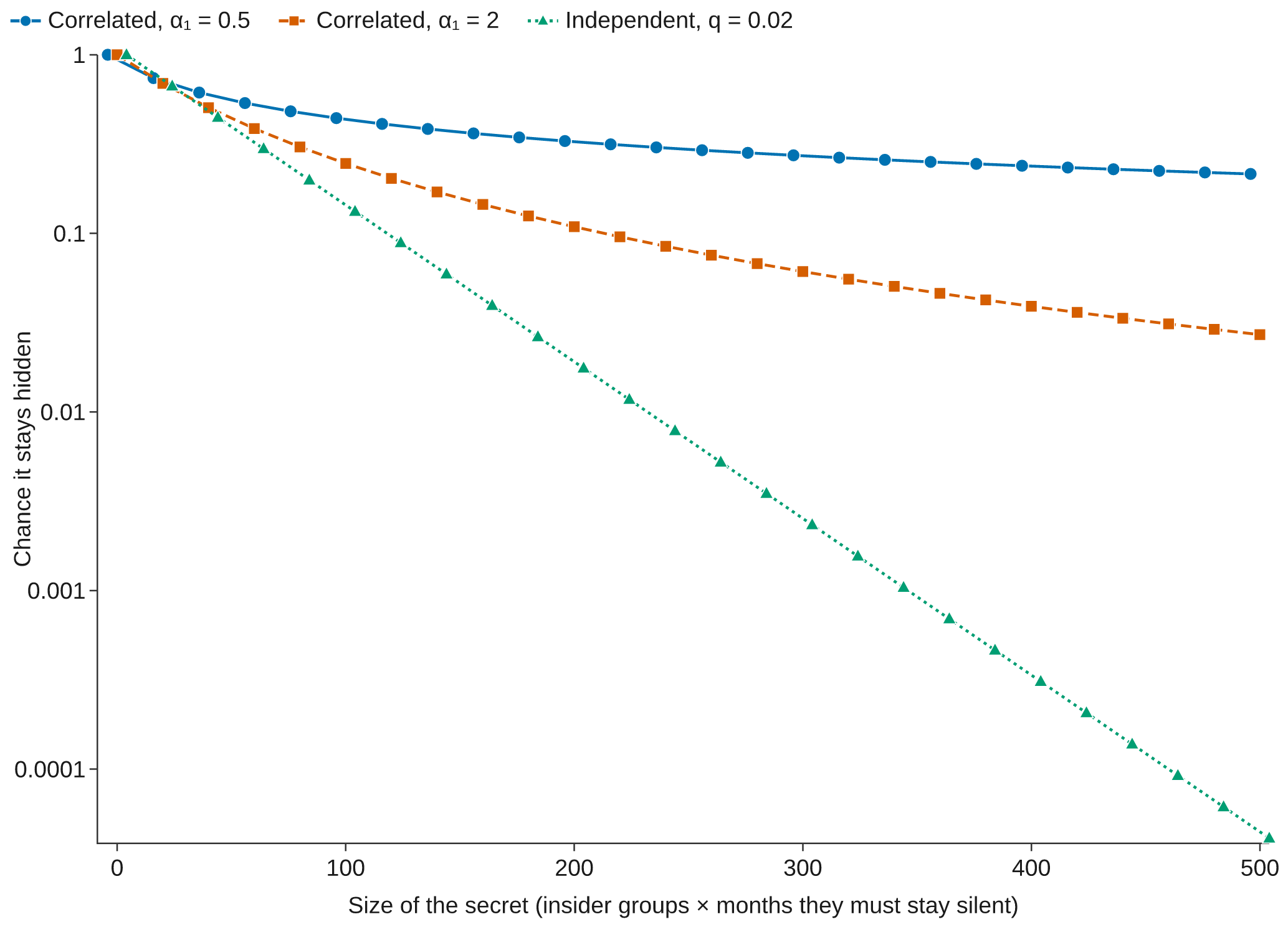
If each group of insiders has an independent 2% chance of coming forward each month, the chance a large program stays hidden collapses (steepest line). A state that terrorizes every insider at once slows that collapse (flatter lines). Illustrative computation, log scale.
The treaty keeps the three pillars of the nuclear Non-Proliferation Treaty. Non-proliferation binds every party, leaders included. Disarmament means every frontier chip without a module is declared, then fitted with one or bought back and destroyed. Peaceful use means a shared compute bank gives every member capable AI at cost, the way international fuel banks supply nuclear fuel in exchange for restraint. Verification reveals counts, locations and license identifiers, never model designs, data or weights, and a party's restraint tomorrow is enforced by its own hardware rather than its promise. Every year more of the world's compute carries modules, so walking away costs more. Most arms-control agreements erode. This one is designed to strengthen.
Bitcoin is the only collateral rivals can share
Rules between rivals need consequences, so Firebreak has every operator of frontier compute, and every country, post a bond it loses for breaking the rules, and it pays rewards to anyone who exposes a violation. That collateral can have no issuer or custodian among the parties. It has to move without permission, keep a public and ordered record, avoid creating an institution whose capture would capture the regime, and be secure enough that attacking it costs more than the stakes. Central-bank reserves can be printed or frozen, gold needs a custodian, and a token made for the treaty hands its operator a lever. Bitcoin is the only existing asset that meets all six as well as anything can: nobody can print, freeze or block it, and its history is public and ordered by proof of work.
The bonds cannot be dodged. Before a bond is funded, the operator pre-signs the transactions that would pay it out as a penalty to the reward pool. Once a violation is proven, the penalty can be completed but not redirected: the enforcing council cannot take the money, and the operator cannot block it because it already signed. Machine-provable violations, such as a chip telling two different stories about the same period, can be enforced by anyone through Bitcoin's own scripts. All of it works on Bitcoin as it is today, with no change to its rules.
The bounties cannot be intercepted. An insider in a country running a covert program has every reason to distrust a reward paid through that country's banks. Firebreak pays in bitcoin to a key that can be a memorized phrase, carried across a border in the insider's head. The insider can confirm on the public chain that the reward pool really holds the money before coming forward, and need not spend it until out of reach.
I should be plain about my interests: I mine and hold bitcoin, and adoption of this settlement layer could raise demand for it and benefit me financially. The properties that make Bitcoin sound money among individuals who do not trust each other are exactly the properties rival nations need to trust a shared set of consequences. Bitcoin does not replace treaties, inspections or chips that enforce rules. It is what lets them keep their promises.
Firebreak makes cheating costly, not impossible
Firebreak does not make superintelligence impossible. Under assumptions that can be stated and checked, it makes building weapons-grade intelligence detectable, unprofitable and self-defeating for every actor short of a state with its own chip industry outside the regime. That state is the largest limit. Firebreak can make its program slow, visible and costly, but not impossible, and the answer is political: making membership worth more than going it alone.
The second limit is a clock. Compute controls work only while frontier capability needs concentrated computing power, and algorithms keep getting more efficient while training can be spread across scattered machines.
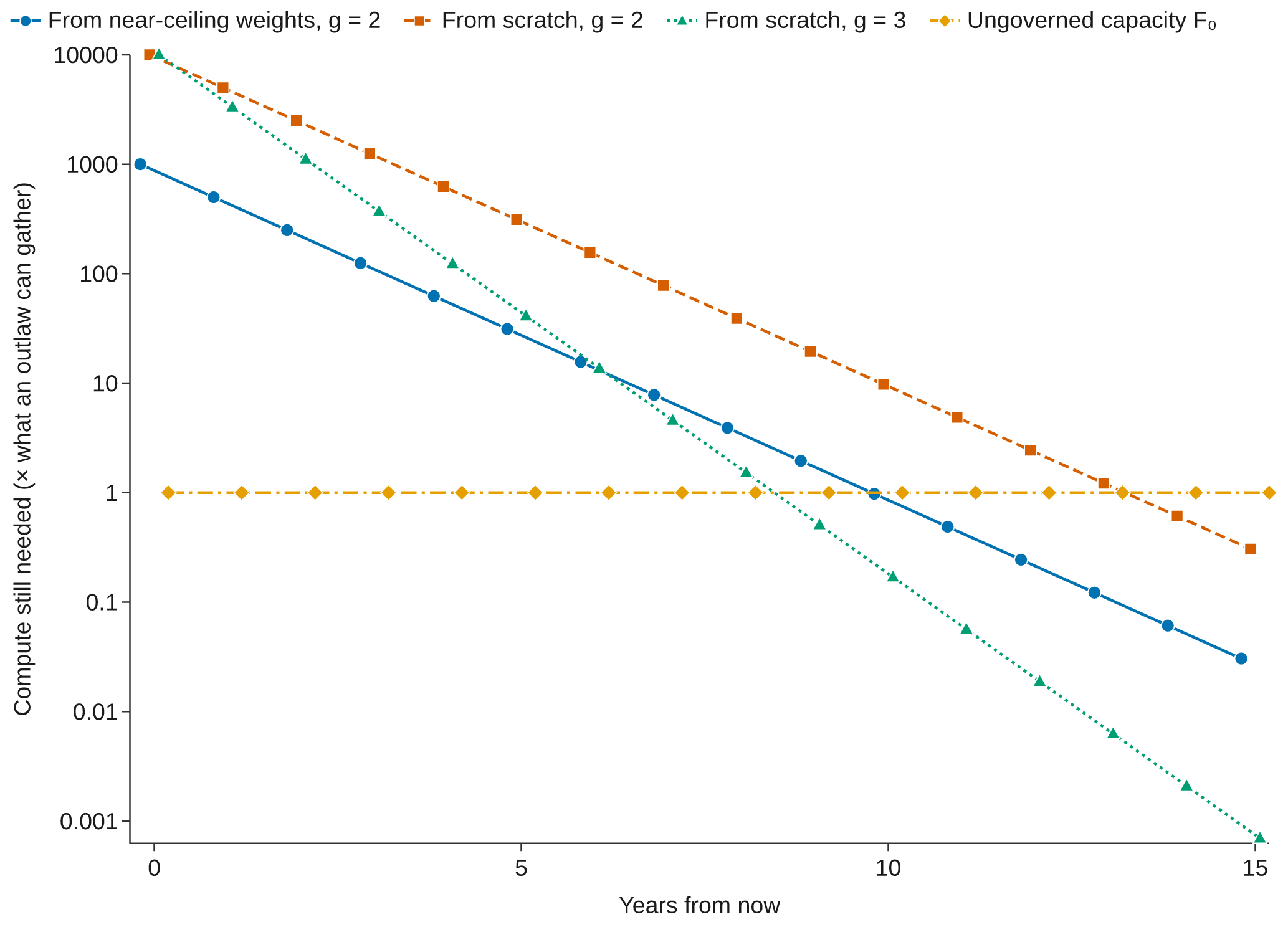
An outlaw that starts out needing ten thousand times the compute it can gather in secret closes the gap in roughly thirteen years if efficiency doubles each year, and sooner with faster progress or stolen near-ceiling weights. Illustrative computation, log scale.
Firebreak recomputes that date at every review and uses the time to strengthen what does not depend on compute: the human-approval rules, capability controls and narrow restrictions on research whose main effect is to make training far more efficient. It also cannot stop misuse of smaller systems, the slow handover of human roles to machines, or a system that is already weapons-grade before the regime's hardware exists. Nothing in the design makes governments sign. It is built to be worth signing.
Most of this can start before any treaty
AI developers can anchor a regular cryptographic fingerprint of their computing inventory and training records on Bitcoin, which reveals nothing but fixes a record a later audit can check, adopt the two-person rule for large training runs with no AI holding signing keys, and post voluntary bonds in bitcoin to show they mean their safety commitments. Governments that host the chipmaking choke points can fit guarantee modules to new frontier chips in shadow mode, logging what they would have throttled without throttling anything, and fund a pilot bounty, paid in bitcoin, for evidence of undeclared data centers or diverted chips. The Bitcoin community can build and audit the bond, penalty and reward tooling and run the nodes that keep the clock honest. Everyone else can ask for verification instead of promises: when a company or a government says its AI is safe, ask how anyone else would check.
The full technical paper, with formal proofs, protocol specifications and draft treaty articles, is coming. Until then, firebreak.space lets you run the models yourself.
The race to superintelligence is not a force of nature. It is a set of choices made by a small number of organizations and governments, each afraid that someone else will get there first, and while the most capable AI still depends on a concentrated supply of chips, those choices can still be made differently. A firebreak does not put out a fire. It is a cleared line that keeps the fire from spreading while the harder work of making advanced AI safe gets done.